Table of Contents
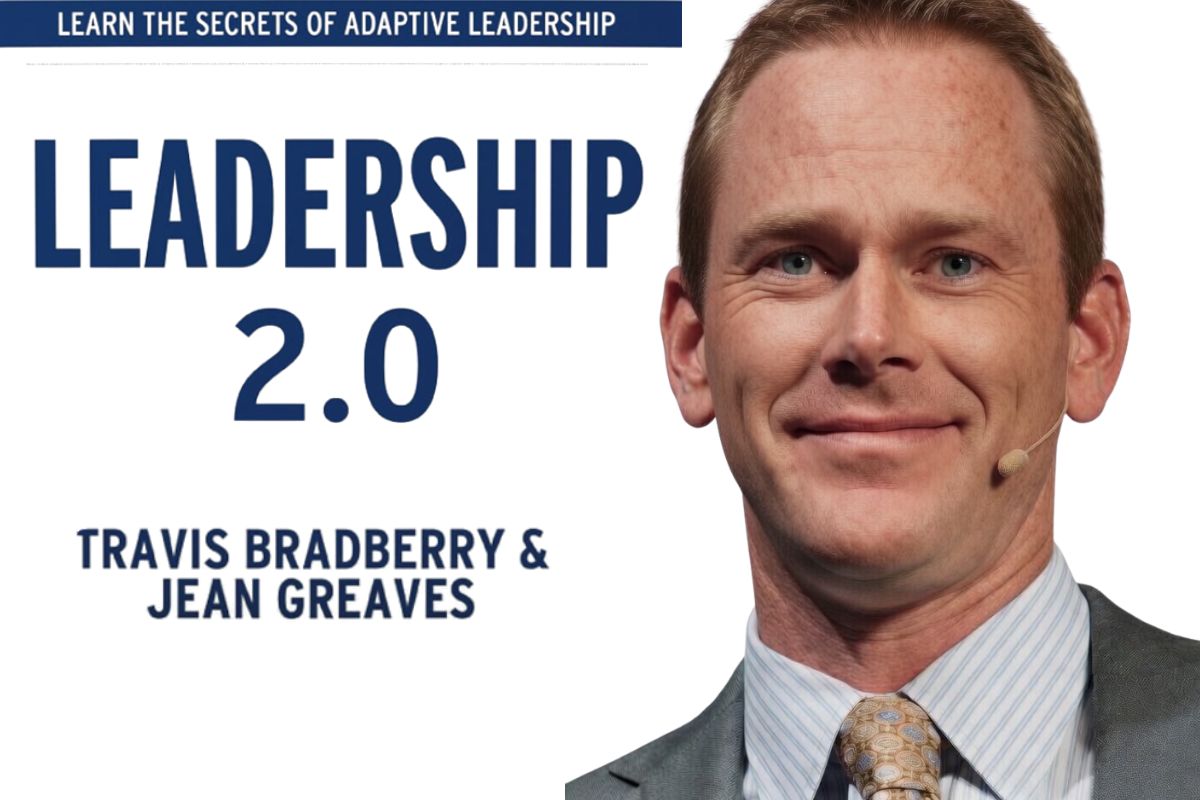
Leadership 2.0
Most leaders believe they know where they are strong and where they need work. Research says otherwise — not occasionally, but systematically, and most severely in the skills that matter most. Travis Bradberry and Jean Greaves, the researchers and co-founders of TalentSmart, found that the five skills leaders most dramatically overestimate in themselves are all adaptive leadership skills — the precise skills that separate genuinely great leaders from merely competent ones. The gap between self-perception and reality is not a personality flaw. It is a structural blindspot, and it is costing organisations more than most leadership teams are prepared to acknowledge. Leadership 2.0, their research-backed framework built on data from leaders worldwide, exists to close that gap — systematically, measurably, and without illusion.
1. Why Most Leadership Books Get This Wrong
Leadership literature has a recurring problem. It tends to tell leaders what great leadership looks like — the inspiring vision, the decisive action, the authentic presence — without explaining how to build those capacities in practice. Most leadership books are long on aspiration and short on instruction. Bradberry and Greaves took a different approach. They started with data.
Their study began with a straightforward question: which of the many skills attributed to effective leaders actually produce results? The 360° Refined™ assessment, completed by leaders across industries and countries, measured 22 discrete leadership skills and correlated them directly with outcomes — performance ratings, team results, and career trajectory. The findings were clear and, for many leaders, uncomfortable.
Not every skill attributed to great leadership actually produces it. Some widely celebrated leadership qualities are largely irrelevant to measurable results. Others are genuinely critical but consistently underestimated in importance — and leaders routinely overestimate their own proficiency in exactly those areas. The honest implication is that most leaders are investing in the wrong things, developing the skills they already possess while neglecting the ones that would make the greatest difference.
The book’s central contribution is structural. It organises all 22 critical leadership skills into two tiers — core and adaptive — and gives every reader a framework for assessing where they stand and precisely what to do about it. That is what makes Leadership 2.0 worth examining in detail. It is not a motivational text. It is a diagnostic and development system. For leaders serious about improvement, those are very different things.
2. The Architecture: Core vs Adaptive Leadership
The distinction between core and adaptive leadership is both the book’s organising principle and its most important finding.
| CORE LEADERSHIP (The Foundation) | ADAPTIVE LEADERSHIP (The Differentiator) |
|---|---|
| Strategy Vision, Acumen, Planning, Courage to Lead | Emotional Intelligence Self-Awareness, Self-Management, Social Awareness, Relationship Management |
| Action Decision Making, Communication, Mobilizing Others | Organizational Justice Decision Fairness, Information Sharing, Outcome Concern |
| Results Risk Taking, Results Focus, Agility | Character Integrity, Credibility, Values Differences |
| Development Lifelong Learning, Developing Others |
Core leadership skills are the skills that earn people leadership positions in the first place. They are the capabilities that produce visible results in the short term — strategy, decision making, communication, risk taking. These skills are necessary, learnable, and well understood. They form the floor of leadership effectiveness. Without them, nothing else works. But they are not what makes leaders truly exceptional.
Adaptive leadership skills are what set the world’s genuinely great leaders apart. They are harder to see, harder to measure, and — critically — harder for leaders to accurately assess in themselves. The four adaptive skill clusters Bradberry and Greaves identify are emotional intelligence, organisational justice, character, and the development of others. These are not soft skills in the dismissive sense that phrase implies. They are the skills that build institutional trust, sustained performance, and human commitment that no strategy document can generate on its own.
The research finding that most challenges leaders is this: the five skills in which leaders most overestimate their own proficiency are all in the adaptive category. Leaders tend to believe they are more emotionally intelligent, more fair, and more invested in developing their people than they actually are — at least as experienced by those they lead. The 360° assessment, which captures the perspectives of peers, direct reports, and superiors alongside self-ratings, consistently reveals this gap. Closing it is, according to the authors, the single greatest opportunity available to any leader.
Understanding this architecture matters particularly for entrepreneurs and founders. The skills that build a business in its early stages — drive, decisiveness, strategic instinct, hands-on execution — are core leadership skills. They are what get you here. But as a business grows, as teams expand and the complexity of managing people multiplies, the adaptive skills become the determining factor. The leader who cannot develop emotional intelligence, who runs an organisation without fairness or trust, who never invests in developing others, will eventually hit a ceiling that no amount of strategy or hard work can break through.
For those working through practical business frameworks for leadership development, this distinction — between what got you here and what will take you further — is one of the most clarifying ideas in the leadership literature.
3. Foundation Skills: Strategy, Action, and Results
The three core leadership skill clusters cover the ten skills that leaders must develop to function effectively in any organisational role. Bradberry and Greaves treat each cluster as a system: the skills within it are interdependent, and a weakness in one undermines the others.
3.1 Strategy: Vision, Acumen, Planning, and Courage to Lead
Strategy comprises four skills: vision, acumen, planning, and courage to lead.
Vision is defined precisely — not as a mission statement or a set of corporate values displayed on a wall, but as a central pursuit that gives people a reason to work beyond the paycheck. The authors cite a sharp observation that practitioners in any sector will recognise: people will work hard for a salary, harder for a person, but hardest of all for a purpose. A workable vision meets six tests. It is easy to communicate, motivating to pursue, realistic enough to execute, comprehensible enough to spread by word of mouth, and alive enough that people will continue pursuing it even when the leader is not in the room.
Acumen requires the ability to hold the operational and the strategic simultaneously. It is not about being across every function in detail, but about being sufficiently fluent in each part of the business to understand how they interact and where genuine competitive advantage is available. The authors suggest a set of questions leaders should ask themselves regularly: what events are shaping the world, the industry, and the organisation, and what do those events mean for strategy?
Planning is where strategy meets execution — and where most strategies die. The authors identify the most common planning failures with brunt clarity: insufficient resources, unrealistic timelines, and failure to account for disruption. Courage to lead is what connects the other three. Without the willingness to make difficult decisions, challenge existing assumptions, and address conflict before it festers, even the most compelling strategy remains theoretical.
3.2 Action: Decision Making, Communication, and Mobilising Others
The action cluster covers decision making, communication, and mobilising others. The decision-making section is particularly useful for leaders who confuse confidence with competence. Bradberry and Greaves argue that sound decision making is a process discipline, not a talent. The most reliable decisions follow a structured approach: separate emotion from analysis, seek counsel from people with different perspectives, distinguish raw data from validated knowledge, consider every angle, perform a cost-benefit analysis, and apply what the authors call the integrity gut check — asking whether you would be comfortable explaining this decision to someone whose judgement you respect.
Communication is described without equivocation as the real work of leadership. The authors make a pointed observation about one-way communication: leaders who treat it as broadcasting rather than dialogue consistently undermine the trust and performance of their teams. The gap between leaders who speak at people and leaders who speak with them is not a stylistic preference — it produces measurably different outcomes.
Mobilising others is distinguished from the far weaker concept of employee satisfaction. A satisfied employee will do the job without complaint but will not give discretionary effort — the additional commitment that separates good organisations from excellent ones. Research cited in the book found that companies with genuinely engaged workforces have substantially higher profit margins than those with merely satisfied staff. Engagement is built through genuine recognition, clarity of responsibility, earned respect, and open access.
3.3 Results: Risk Taking, Results Focus, and Agility
The results cluster addresses the invisible barriers that prevent good strategy from producing actual outcomes. The 70% certainty rule, introduced in the risk-taking section, is one of the book’s most immediately applicable ideas: if you are waiting for 100% certainty before acting, you are waiting too long. Sound leaders act when they have adequate information, not when they have complete certainty — a distinction that separates those who create momentum from those who manage process.
Results focus keeps the organisation oriented toward its actual objectives rather than the comfort of activity. The authors are emphatic that leaders who do not follow through breed cynicism — a corrosive force that quietly destroys people’s motivation to pursue organisational goals. Agility is about anticipating change rather than merely reacting to it, making disruption a source of competitive advantage rather than a source of crisis.
4. Emotional Intelligence: The Skill Leaders Underestimate Most
The transition from core to adaptive leadership begins with emotional intelligence, and it begins with a neurological observation that most leadership training ignores. The brain is wired to process emotion before rational thought. Every experience — every piece of feedback, every difficult conversation, every setback — travels through the limbic system before it reaches the prefrontal cortex where reasoning occurs. The first response to any significant event is always emotional. Leaders who are unaware of this will be managed by it. Leaders who understand it can choose what to do with it.
The empirical case for emotional intelligence (EQ) is formidable, and Bradberry and Greaves present it without embellishment. People with the highest IQs outperform those with average IQs only 20% of the time. People with average IQs outperform the highest IQ individuals 70% of the time. The differentiating variable is emotional intelligence. Among the leaders studied, 90% of top performers scored high in EQ. Only 20% of bottom performers did. Every point increase in EQ added an average of $1,300 to annual salary across the dataset — and EQ, unlike IQ, is developable at any stage of a career. The data is not a verdict. It is an invitation.
4.1 Self-Awareness: The Foundation
Self-awareness is the foundational EQ skill — the ability to accurately perceive your own emotions in real time and understand your behavioural tendencies across situations. Without it, no other EQ skill functions properly. The finding that 83% of top performers are high in self-awareness, while only 2% of bottom performers are, makes the argument without further qualification.
Building self-awareness requires leaning into discomfort rather than avoiding it, listening to what emotions are communicating before acting on them, and seeking feedback from people who will be genuinely honest rather than protective. The authors make one particularly sharp observation: pay close attention to what irritates you in other people — because it frequently reveals something you have not yet accepted about yourself.
4.2 Self-Management: Channelling Emotion Constructively
Self-management builds on self-awareness and is the ability to use emotional awareness to stay flexible and direct behaviour toward positive outcomes. It is not about suppressing emotion. It is about making a deliberate choice about what to do with it. Real self-management means managing tendencies over time, not just controlling obvious outbursts in high-stakes moments.
The emotional tone a leader sets is contagious. Leaders who cannot regulate their own emotional state become destabilising forces in their organisations, regardless of how technically capable they are in other dimensions. The authors include strategies for managing positive emotions as carefully as negative ones — because unchecked enthusiasm is just as capable of derailing sound judgement as unchecked frustration.
4.3 Social Awareness: Reading the Room Accurately
Social awareness is the capacity to accurately perceive the emotional reality of others — what people are thinking and feeling even when they are not saying so. It requires, above all else, the discipline to stop talking long enough to observe. Leaders who fill every silence with their own perspective consistently miss what is actually happening in their teams.
The authors suggest playing what they call anthropologist — observing interactions without allowing personal reactions to distort interpretation. Picking up the mood in a room before speaking, testing observations by asking reflective questions rather than making assumptions, and conducting a regular brief tour of the office to stay attuned to what is happening below the surface are all actionable techniques.
4.4 Relationship Management: Putting It All Together
Relationship management integrates the other three EQ skills and is defined as the ability to use awareness of your own emotions and those of others to manage interactions successfully. The authors focus particular attention on conflict, which tends in most organisations to either fester unaddressed or escalate unnecessarily. The framework they provide for navigating difficult conversations — opening with a point of genuine agreement, inviting the other person’s perspective before defending your own, resisting the urge to retaliate, and maintaining the relationship through deliberate follow-up — is detailed enough to apply in practice.
For leaders who want to go deeper on applying emotional intelligence and decision intelligence in complex business environments, the work being done at Twinlabs on AI-assisted decision support offers a useful complement to the human EQ dimensions Bradberry and Greaves explore. Similarly, those looking for structured AI coaching for business leadership development will find the EQ framework maps directly onto how effective coaching conversations are structured.
5. Organisational Justice, Character, and Developing Others
These three adaptive skill clusters tend to receive the least investment from leaders and produce some of the most visible damage when neglected.
5.1 Organisational Justice: Fairness as a Leadership Discipline
Organisational justice addresses something most leaders have not named but every employee has experienced: the sense that their contributions are, or are not, genuinely valued. The book opens this section with a finding that has held across decades of workplace research — most people do not dread their work. They dread the people who have power over them. When organisational justice is absent, people become resentful, disengaged, and professionally absent while technically still present. When it is present, they bring discretionary effort without being asked.
The insight that makes this section particularly actionable is this: creating justice does not require restructuring the organisation. It requires changing three specific leader behaviours. Decision fairness is not about making popular decisions — it is about using a fair process to make them. Research consistently shows that employees accept unfavourable outcomes far more readily when they believe the process was transparent and their input was genuinely considered before the decision was finalised.
Information sharing requires leaders to explain not just what was decided but how and why. Employees do not need to agree with a decision for information sharing to benefit them — they simply need to understand the rationale. The mere presence of a sincere explanation, the authors note, positively influences how people respond to outcomes they would not have chosen themselves. Outcome concern is genuine, demonstrable care for how decisions affect the people who must live with them. When employees leave organisations, they are not leaving jobs. They are leaving leaders who showed no evidence of caring about them.
5.2 Character: Consistency Under Pressure
Character is defined practically rather than philosophically. It is the consistency between what you say, what you do, and what the organisation values — tested most severely when leaders have power and face adversity. The authors draw on Lincoln’s observation that nearly any person can stand adversity, but to test character, give them power.
Integrity in this framework is not a declaration. It is the invisible thread employees track in every email, every hallway conversation, and every boardroom decision made under pressure. Losing it is easy — it can happen in a single moment of self-interest or fear. Rebuilding it is slow and requires deliberate recommitment to consistency between stated values and actual behaviour.
Credibility is distinct from integrity. It is built on expertise, reliability, and consistent behaviour over time. It is granted by others, never self-awarded, and can be destroyed in a single misaligned moment. Knowing when to remain silent is as important as knowing when to speak — leaders who talk constantly to demonstrate their authority typically undermine it. Valuing differences addresses the most common and costly character failure: surrounding yourself with people who think like you, defer to you, and confirm your existing view. The organisations that achieve the most are built on genuine diversity of thought, not demographic compliance or managed agreement.
5.3 Developing Others: The Leadership Multiplier
Developing others is where the authors make their strongest case for leadership as a multiplier function. The leaders who achieve the most are those who grow the people around them — deliberately, consistently, and with genuine investment. The moment a leader believes they have nothing more to learn and that developing others is someone else’s job, they have guaranteed they will never reach their true potential.
Framing developmental intent clearly — so people understand they are being invested in, not criticised — is the starting point. Creating psychological safety around failure is the structure that makes growth possible. Asking rather than telling, coaching rather than directing, and revealing your own failures to normalise the learning process are the behaviours that distinguish leaders who develop people from those who merely manage output.
For professionals navigating the transition from practitioner to leader, AI coaching for business increasingly supports the kind of self-directed development the authors advocate — identifying blindspots, structuring development plans, and building the habits that make adaptive skills durable over time. The Twinlabs decision intelligence platform similarly supports evidence-based thinking in complex leadership environments where the stakes of getting decisions wrong are high.
6. 12 Lessons Every Leader and Entrepreneur Can Use Now
The following twelve lessons distil the most immediately actionable insights from Leadership 2.0. They are written for leaders building organisations or managing through complexity — not for those preparing for a leadership role, but for those already in one.
1. Know which skills got you here and which ones will take you further. Core leadership skills — strategy, action, results — earn the leadership role. Adaptive skills — emotional intelligence, organisational justice, character, and developing others — determine whether the role produces lasting impact. Both require deliberate, ongoing investment.
2. Measure before you improve. The fundamental argument of the 360° Refined™ framework is that you cannot develop what you cannot see. Before working on any leadership skill, take a structured self-assessment and, where possible, collect honest feedback from peers, direct reports, and superiors. Blindspots are the biggest constraint on growth — not the skill gaps you can already name.
3. Build a vision that people can spread without you. Test your current vision against six criteria. Is it easy for others to articulate? Does it generate energy without requiring your presence? Is it realistic enough to pursue? Would people still be working toward it if you left the room? If the answer to any of these is no, the vision needs work — not the team.
4. Use a structured process for decisions, not just instinct. Sound decision making follows a method: separate emotion from analysis, seek input from people with different perspectives, distinguish what you know from what you believe, perform a cost-benefit analysis, do an integrity check, and prepare contingencies. These steps do not slow good decisions. They prevent bad ones.
5. Communicate to be understood, not just to be heard. Read your audience continuously. Speak to groups as individuals. Listen more than you talk. Connect emotionally by being transparent about what matters to you and why. Prepare your intent before every important conversation — know what you are trying to achieve before you open your mouth.
6. Engage your people — do not merely satisfy them. Satisfaction is a low bar that produces compliance without commitment. Engagement — built through genuine recognition, clarity of responsibility, earned respect, and a culture where people feel valued — produces the discretionary effort that drives exceptional results. For leaders working through this for the first time, practical step-by-step guides from 1 Hour Guide provide a useful starting point for building engagement systems that do not require large teams or budgets.
7. Take the right risks, not just the comfortable ones. Most leaders take risks in strategy but remain risk-averse in how they interact with people. The leaders who generate the deepest loyalty are also personally vulnerable — they acknowledge mistakes, share hard truths, and let people see them as human rather than as a function. The 70% certainty rule is worth memorising: act when you have adequate information, not when you have complete certainty.
8. Manage your emotions before they manage your organisation. Your emotional state is contagious. The neural pathway ensures that emotion precedes rational thought in every significant interaction. The question is not whether you will feel pressure, frustration, or anxiety in leadership. The question is whether you will be aware of it and channel it deliberately. High EQ is learnable and produces demonstrable results in both performance and relationships.
9. Make every decision through a fair process, not just a correct one. Informing people before a decision is finalised, giving them genuine input, and demonstrating care for how the outcome affects them are three behaviours that change how people experience your leadership — even when the decision itself is unfavourable. Fairness of process is as important as fairness of outcome.
10. Build credibility in small doses every day, and treat it as your most valuable asset. Credibility is built through consistent action over time and lost in a single misaligned moment. Never ask your people to do what you are unwilling to do yourself. Know when to speak and, equally important, when to remain quiet. Leaders who talk constantly to demonstrate authority typically undermine it.
11. Invest in developing your people as seriously as you invest in strategy. The leaders who achieve the most are those who multiply their capacity through others. Frame developmental intent clearly so people understand you are investing in them. Create safety around failure. Ask rather than tell. Hold people to written development goals. Leaders integrating technology into development will find that AI coaching for business and structured development frameworks from 1 Hour Guide both offer systematic approaches to building this capability without requiring a large HR function.
12. Commit to lifelong learning by keeping ego in check. Success is the most dangerous enemy of learning because it creates the illusion that you have arrived. The adaptive leaders who continue to grow treat failure as data, seek feedback that is honest rather than comfortable, read outside their existing knowledge base, and remain genuinely curious about what they do not yet know. Ego is not ambition. It is the force that kills ambition once it no longer needs to prove itself.
7. In Closing
Leadership 2.0 is not a book that tells leaders they are capable of greatness and then leaves them to figure out the path. It identifies 22 discrete skills, organises them into a two-tier framework, shows you exactly where most leaders are blind, and provides a structured approach to improving every one of those skills. That is a different proposition from most leadership literature, and it is why the framework has remained relevant more than a decade after its initial publication.
The central argument is both clarifying and challenging. The skills that made you successful are not the same skills that will make you great. Greatness requires the adaptive skills — emotional intelligence, organisational justice, character, and developing others — that most leaders underinvest in precisely because they are harder to see and harder to measure. Leadership 2.0 makes them visible, measurable, and learnable. For any leader serious about closing the gap between how they see themselves and how others experience them, that is where the real work begins.