Table of Contents
What is “Mastery”?
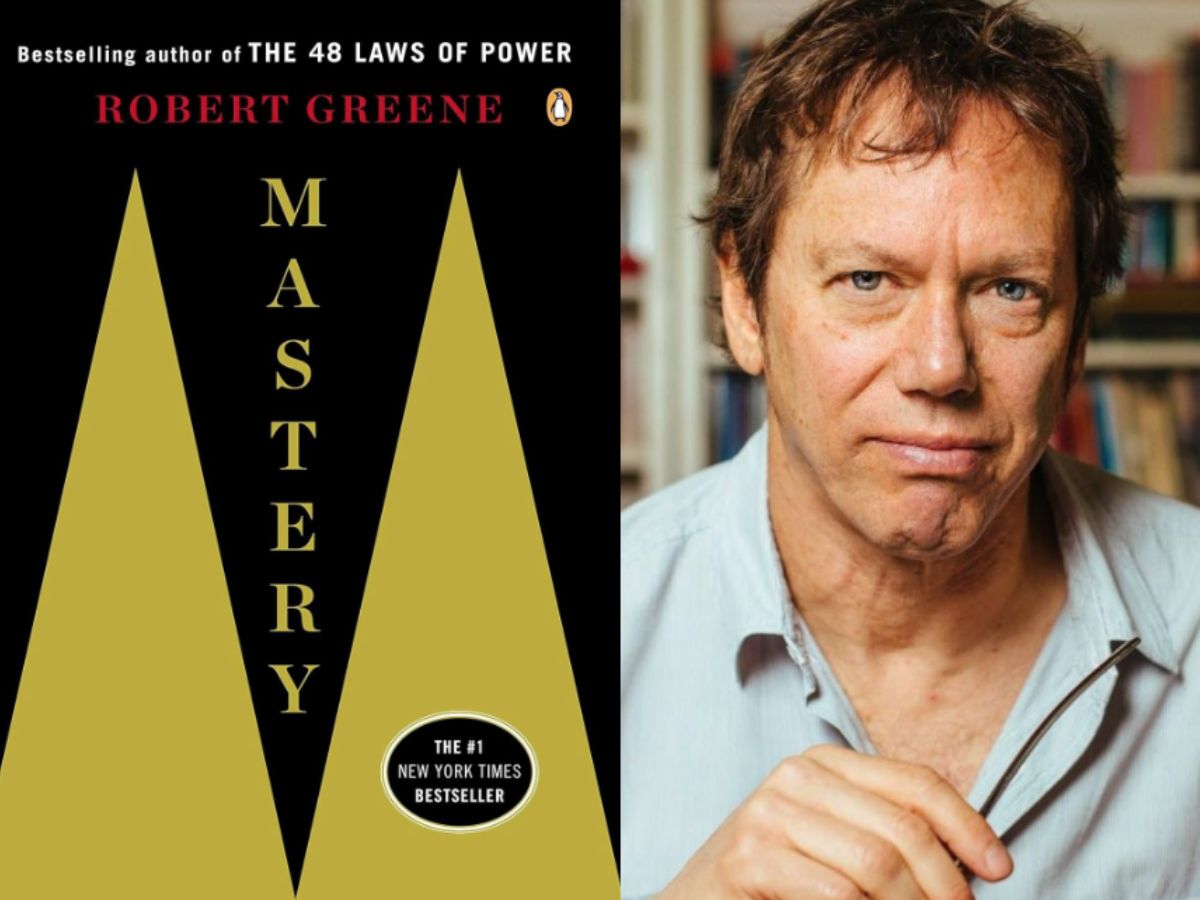
In the hyper-competitive world of entrepreneurship, where AI disrupts industries overnight and attention spans shrink to seconds, what separates the fleeting success stories from the legendary builders? According to Robert Greene’s groundbreaking book Mastery (2012), the answer isn’t raw talent, luck, or even hustle. It’s a deliberate, six-phase process that unlocks “the ultimate power” — a higher form of intelligence that lets you see deeper into reality, anticipate trends, and shape outcomes others can’t even imagine.
Greene, the bestselling author of The 48 Laws of Power, argues that mastery is not reserved for geniuses like Leonardo da Vinci or Charles Darwin. It’s a repeatable system accessible to anyone willing to follow the hidden path. For entrepreneurs and personal development enthusiasts, this framework is pure gold: it transforms reactive founders into visionary leaders who build unstoppable businesses while achieving profound personal fulfillment.
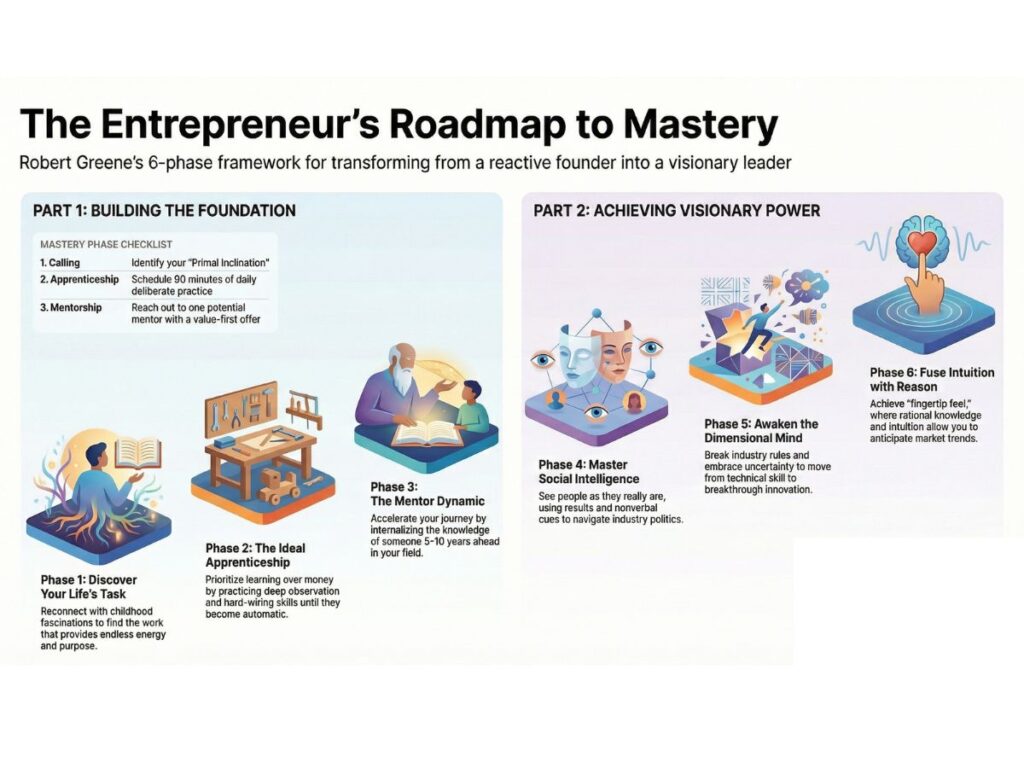
This comprehensive guide distills Greene’s Mastery into a practical, action-oriented blueprint tailored for modern business builders. Whether you’re launching your first startup, scaling a seven-figure company, or seeking deeper purpose in your career, these six phases will show you exactly how to discover your Life’s Task, master skills faster, navigate people politics, ignite creativity, and reach the intuitive “fingertip feel” that defines true mastery.
By the end, you’ll have a clear roadmap — complete with strategies, real-world entrepreneur examples, and immediate action steps — to apply Robert Greene’s Mastery principles today. Let’s dive in.
Phase 1: Discover Your Calling: The Life’s Task
The Foundation of Entrepreneurial Mastery
Robert Greene opens Mastery with a powerful truth: “You possess an inner force that seeks to guide you toward your Life’s Task — what you are meant to accomplish in the time that you have to live.” This hidden force, your primal inclination, is the seed of all greatness. For entrepreneurs, ignoring it is the #1 reason most businesses fail or feel empty even when profitable.
Most founders chase what looks profitable — trending niches, investor hype, or “smart” career moves — instead of what genuinely energizes them. The result? Burnout, pivots that go nowhere, and a business that never reaches its potential. Greene illustrates this with Leonardo da Vinci, who ignored societal pressure and followed his obsessive curiosity about nature, anatomy, and invention. The same principle powered modern icons like Sara Blakely (Spanx) and Elon Musk.
Key Strategies from Mastery for Entrepreneurs:
- Return to Your Origins – The Primal Inclination Strategy
Revisit childhood fascinations, moments of deep absorption, or recurring irritations that sparked energy. Greene cites Albert Einstein’s childhood wonder with magnets and Marie Curie’s early obsession with invisible forces.
Entrepreneur application: Ask yourself: What problem have I complained about for years? What activity makes time disappear? Sara Blakely turned her frustration with pantyhose into a billion-dollar empire because it aligned with her Life’s Task. - Occupy the Perfect Niche – The Darwinian Strategy
Identify where your unique combination of skills meets an underserved market need. A.V.S. Ramachandran and Yoky Matsuoka (robotics pioneer) exemplify carving a niche that feels custom-built for you. - Avoid the False Path – The Rebellion Strategy
Wolfgang Amadeus Mozart’s father pushed him toward court composer fame; Mozart rebelled to follow his true voice. Entrepreneurs often face the same — family expectations, “safe” corporate ladders, or shiny object syndrome. Say no to the false path.
Action Step for Entrepreneurs:
Spend 15 minutes journaling: List three childhood moments of pure fascination and three current business frustrations. Where do they overlap? That intersection is your Life’s Task. Commit to one small experiment this week that honors it (e.g., prototype a product or write a LinkedIn post about it).
Master this phase and everything else in Mastery by Robert Greene flows naturally. Skip it, and you’ll build someone else’s dream.
Phase 2: Submit to Reality – The Ideal Apprenticeship
Where Most Entrepreneurs Quit
Once you discover your Life’s Task, Greene insists you must enter “the most critical phase” — the Ideal Apprenticeship. This is the humble, often tedious period of skill-building that separates amateurs from masters. Entrepreneurs hate it because it feels slow in a “move fast and break things” culture, yet it’s non-negotiable.
Greene uses Charles Darwin’s five-year voyage on the Beagle as the archetype: Darwin didn’t rush to publish; he observed, collected, and internalized reality first.
The Three Steps of the Ideal Apprenticeship:
- Step 1: Deep Observation (Passive Mode) – Mute your ego. Watch power dynamics, unspoken rules, and customer behavior without inserting your opinions.
- Step 2: Skills Acquisition (Practice Mode) – Embrace the 10,000-hour rule through deliberate practice. Hard-wire knowledge until it becomes automatic.
- Step 3: Experimentation (Active Mode) – Gradually assert your own ideas while still under guidance.
Practical Strategies for Busy Entrepreneurs:
- Value Learning Over Money – Benjamin Franklin apprenticed in printing despite low pay because it built irreplaceable skills. Early Stripe and Airbnb founders lived frugally to master their craft before scaling.
- Move Toward Resistance and Pain – Bill Bradley practiced basketball shots he hated; John Keats rewrote poems relentlessly. In business, deliberately tackle your weakest area (e.g., cold outreach or financial modeling).
- Apprentice Yourself in Failure – Henry Ford’s repeated bankruptcies taught him more than success ever could. Treat every failed launch as tuition.
Action Step: Identify your current “apprenticeship gap.” Block 90 minutes daily for deep skill practice (no multitasking). Track progress in a simple notebook. In six months, you’ll feel the transformation Greene describes.
Phase 3: Absorb the Master’s Power – The Mentor Dynamic
Accelerate Your Entrepreneurial Journey
Life is short. Greene warns that wandering alone wastes years. The solution? Find a mentor who is 5–10 years ahead in your exact domain and internalize their knowledge like alchemy.
Michael Faraday apprenticed under Humphry Davy, absorbing not just science but a way of thinking. The goal: surpass your mentor.
How Entrepreneurs Should Choose and Use Mentors:
- Choose According to Your Needs – Match their expertise to your Life’s Task (Frank Lloyd Wright, Carl Jung examples).
- Create a Back-and-Forth Dynamic – Freddie Roach turned mentoring Manny Pacquiao into a two-way street that elevated both.
- Know When to Leave – Thomas Edison outgrew his early influences and forged his own path.
Action Step: Reach out to one potential mentor this week with a specific, value-first offer (e.g., “I analyzed your last three product launches and have three ideas to improve retention”). Document every insight and immediately apply one.
Phase 4: See People as They Are – Social Intelligence
Even brilliant ideas die without social intelligence. Greene calls this the ability to read people realistically instead of through naïve projection. Entrepreneurs lose millions because they misread co-founders, investors, or customers.
Benjamin Franklin mastered this after early social blunders. Greene outlines seven deadly realities (envy, conformism, rigidity, etc.) and four strategies:
- Speak through your work (let results do the talking).
- Craft the appropriate persona.
- See yourself as others see you (Temple Grandin’s self-awareness).
- Suffer fools gladly.
Entrepreneur Application: Use nonverbal cues in pitch meetings. Navigate passive-aggressive team members without emotional drain. Turn envy into fuel.
Action Step: After every key interaction this week, write down: What did their body language reveal? What deadly reality was at play? Adjust your next move accordingly.
Phase 5: Awaken the Dimensional Mind – The Creative-Active Phase
Breakthrough Innovation for Startups
This is where most entrepreneurs plateau — they master basics but never achieve originality. Greene’s Creative-Active phase teaches you to expand knowledge, rebel against rules, and generate ideas that redefine industries.
Wolfgang Amadeus Mozart’s second transformation shows the shift from technical skill to dimensional thinking.
Core Creative Strategies (Condensed for Business):
- Cultivate Negative Capability (stay comfortable with uncertainty — essential for pivots).
- Allow for Serendipity (keep an open mind like Louis Pasteur).
- Alternate the Mind Through “The Current” (create feedback loops with prototypes).
- Revert to Primal Forms of Intelligence (think in images and analogies, not just spreadsheets).
Nine High-Impact Tactics with Examples:
- The Fact of Great Yield (spot anomalies others miss).
- The Evolutionary Hijack (Paul Graham turned constraints into Y Combinator’s superpower).
- Dimensional Thinking (see your market in new dimensions, like Jean-François Champollion decoding hieroglyphs).
Action Step: Pick one rule in your industry you’ve internalized. Break it deliberately this month and document the creative results.
Phase 6: Fuse the Intuitive with the Rational – True Mastery
The Fingertip Feel That Wins Markets
After years of deliberate practice, Greene says you reach the third transformation: mastery. Rational knowledge fuses with intuitive “fingertip feel.” You anticipate trends, make lightning decisions, and operate with effortless power.
Marcel Proust and Jane Goodall exemplify this. For entrepreneurs, it means seeing market shifts before data confirms them (Freddie Roach’s global perspective applied to scaling).
Seven Strategies to Attain Mastery:
- Connect to your environment (primal powers).
- Play to your strengths (supreme focus — Einstein, Temple Grandin).
- Internalize the details (Leonardo da Vinci’s life-force approach).
- Widen your vision (global perspective).
- Synthesize all forms of knowledge (Goethe’s universal man/woman).
Action Step: Schedule weekly “mastery hours” — unstructured time to let ideas simmer. Track intuitive hits versus forced decisions. Over time, you’ll develop the fingertip feel Greene promises.
Conclusion: Become a Contemporary Master Today
Robert Greene’s Mastery reveals that the same brain wired over six million years of evolution is still inside you — designed for exactly this process. The six phases aren’t theory; they’re the proven path taken by every legendary entrepreneur, inventor, and leader.
Start where you are. If you’re stuck in Phase 1, reconnect with your Life’s Task this afternoon. If you’re deep in apprenticeship, lean into the pain. Mastery compounds: each phase builds on the last, turning you into the founder who doesn’t just survive markets — you shape them.
Your Entrepreneur’s Mastery Checklist:
- Phase 1: Identified my Life’s Task?
- Phase 2: Daily deliberate practice scheduled?
- Phase 3: Active mentor relationship?
- Phase 4: Practiced social intelligence this week?
- Phase 5: Broke one industry rule?
- Phase 6: Noticed an intuitive insight I acted on?
The ultimate power Greene describes is waiting. Stop chasing shortcuts. Embrace the process. Read Mastery by Robert Greene, apply these phases, and watch your business — and your life — transform into something inevitable.
Additional reading
- “Outliers: The Story of Success” by Malcolm Gladwell: Gladwell delves into the factors that contribute to exceptional success, highlighting the role of practice, opportunity, and cultural background in the development of mastery.
- “Peak: Secrets from the New Science of Expertise” by Anders Ericsson and Robert Pool: This book delves into the science of expertise and explores how individuals can become masters in their fields through deliberate practice and focused learning.
- “Grit: The Power of Passion and Perseverance” by Angela Duckworth: Duckworth examines the role of passion and perseverance in achieving long-term goals and mastery, emphasizing the importance of grit in personal and professional success.
- “Talent Is Overrated: What Really Separates World-Class Performers from Everybody Else” by Geoff Colvin: Colvin challenges the notion of innate talent and argues that deliberate practice and focused effort are the primary drivers of mastery.
- “The Art of Learning: An Inner Journey to Optimal Performance” by Josh Waitzkin: Waitzkin, a chess prodigy and martial artist, shares his insights on the principles of learning, growth, and mastery through his personal experiences.
- “Mindset: The New Psychology of Success” by Carol S. Dweck: Dweck explores the concept of a growth mindset and how it can impact one’s ability to achieve mastery and overcome challenges.
- “The Talent Code: Greatness Isn’t Born. It’s Grown. Here’s How.” by Daniel Coyle: Coyle investigates the science of skill development and explores how talent is cultivated through deep practice and focused learning.
- “Deep Work: Rules for Focused Success in a Distracted World” by Cal Newport: Newport discusses the importance of deep, concentrated work and how it can lead to mastery and productivity in various fields.
- “The Obstacle Is the Way: The Timeless Art of Turning Trials into Triumph” by Ryan Holiday: Holiday draws from Stoic philosophy to show how obstacles and challenges can be opportunities for growth and mastery.