
Table of Contents
Introduction to “Feel The Fear and Do It Anyway”
“Feel the Fear and Do It Anyway” is a self-help book written by Susan Jeffers, originally published in 1987. The book is designed to help readers overcome their fears and achieve personal and professional growth. It has been widely popular and has had a lasting impact on the self-help genre.
Key concepts and principles
- Understanding Fear: Jeffers discusses the nature of fear and how it often holds people back from pursuing their goals and dreams. She emphasizes that fear is a natural part of life and that everyone experiences it.
- The Five Truths About Fear: Jeffers outlines five truths about fear:
- The fear will never go away as long as you continue to grow.
- The only way to get rid of the fear of doing something is to go out and do it.
- The only way to feel better about yourself is to take action.
- Not only are you afraid when you’re about to step out of your comfort zone, but you also feel great afterward.
- The only way to conquer your fear is to “feel the fear and do it anyway.”
- Taking Responsibility: Jeffers encourages readers to take responsibility for their own lives and choices. She believes that by taking responsibility, individuals can regain a sense of control and reduce feelings of helplessness.
- Changing Your Thoughts: The book suggests that changing the way you think about fear and challenges can have a significant impact on your ability to overcome them. Positive affirmations and reframing negative thoughts are techniques Jeffers promotes.
- Action as the Cure: Jeffers emphasizes the importance of taking action, even when you feel afraid. She argues that by taking action, you build confidence and diminish the power of fear over your life.
- Expanding Your Comfort Zone: The book encourages readers to gradually expand their comfort zones by taking small risks and gradually working their way up to bigger challenges.
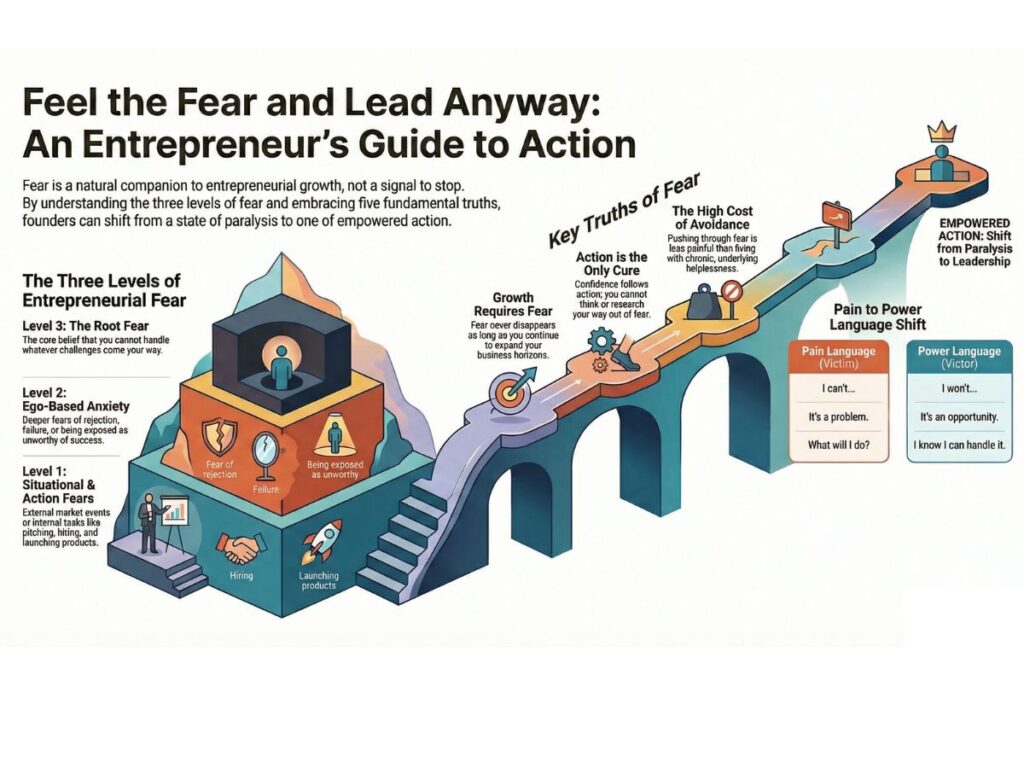
From Fear to Action: A Practical Guide for Entrepreneurs
Fear is the invisible force that kills more businesses than any market downturn ever could. It paralyzes entrepreneurs at crucial moments, prevents necessary pivots, and keeps brilliant ideas locked inside talented minds. Yet fear is not the enemy entrepreneurs need to eliminate. Rather, it’s a companion that signals growth, opportunity, and the edge of possibility. Susan Jeffers’ transformative framework provides entrepreneurs with practical tools to convert fear from a barrier into fuel for building exceptional businesses.
Understanding Your Entrepreneurial Fears: The Three-Level Framework
According to the sources, Susan Jeffers’ framework categorises fear into three distinct levels to help entrepreneurs map and understand their anxieties.
Level 1: Surface Fears
These are the most common fears and are split into two specific categories:
- Things that “happen” to you: These involve external forces such as market crashes, competitors launching similar products, funding falling through, or economic recessions.
- Things that require “action”: These are fears that often lead to procrastination or perfectionism, such as pitching to investors, hiring or firing staff, raising prices, or launching a product before it feels perfect.
Level 2: Ego-Based Fears
These fears cut deeper than Level 1 and involve one’s internal sense of self-worth. They explain why surface-level fears feel so paralysing. Examples include:
- Fear of rejection by the market, investors, or peers.
- Fear of failure that might confirm inner doubts about one’s abilities.
- Fear of success, which brings increased visibility, scrutiny, and high expectations.
- Fear of being exposed as inadequate or undeserving of success.
Level 3: The Root Fear
This is the deepest level and the root cause of all other fears. It is the fundamental belief that “you cannot handle whatever comes your way”. Jeffers argues that if an entrepreneur truly trusted their ability to handle any outcome—whether it be a startup failure, investor rejection, or public criticism—those situations would lose their power to cause paralysis. The ultimate solution to Level 3 fear is the realization that while you may not want to experience a negative event, you can handle it.
The Five Truths Every Entrepreneur Must Accept
There are the five fundamental truths about fear that every entrepreneur must accept to transform their business and personal growth:
- Fear will never go away as long as you continue to grow. This truth contradicts the myth that successful founders are fearless; instead, they simply become better at acting despite their fear. As an entrepreneur moves from one milestone to the next—such as from a first hire to scaling a global team—new challenges will always bring new fears because growth requires entering unfamiliar territory.
- The only way to get rid of the fear of doing something is to go out and do it. You cannot think, research, or plan your way out of fear. Action is the only cure; for example, the fear of cold calling only diminishes after making calls, not by reading about sales techniques.
- The only way to feel better about yourself is to take action. A common mistake is waiting to feel confident before acting. In reality, confidence follows action rather than preceding it. By putting something imperfect into the world, entrepreneurs generate the validation and confidence needed to proceed.
- Everyone experiences fear when in unfamiliar territory. It is a mistake to assume that competitors or successful investors are not afraid. Recognizing that fear is universal and not a personal weakness or character flaw helps remove the isolation and shame that can paralyze a founder.
- Pushing through fear is less frightening than living with the underlying helplessness that comes from avoidance. Choosing to avoid a challenge doesn’t eliminate fear; it trades acute, temporary discomfort for chronic anxiety and the permanent regret of wondering “what if?”.
As we discussed in the summaries, Jeffers recommends daily repetition of these truths—such as writing them on mirrors or dashboards—to help the subconscious mind internalize them as automatic thoughts.
The entrepreneurial journey comes with guarantees, though not the ones most founders hope for. Jeffers identifies five truths about fear that fundamentally reframe the entrepreneurial experience.
Truth 1 states that fear will never disappear as long as you continue growing. This contradicts the mythology that successful entrepreneurs become fearless. In reality, successful founders simply get better at acting despite fear. The entrepreneur who overcomes the fear of making their first hire will face new fears when scaling to 100 employees. The founder who conquers the fear of their first product launch will experience different fears when expanding internationally. Each new level of success brings new fears because growth requires entering unfamiliar territory.
Sara Blakely’s journey with Spanx illustrates this perfectly. She started with the fear of calling Neiman Marcus buyers without appointments. After succeeding, she faced fears about manufacturing at scale. After building a successful company, she faced fears about whether to take outside investment. Each milestone brought new fears, yet she continued acting despite them. Accepting that fear is permanent removes the expectation that you should feel confident before acting, which is the expectation that stops most entrepreneurs from ever starting.
Truth 2 establishes that the only way to eliminate the fear of doing something is to actually do it. Entrepreneurs cannot think their way out of fear. They cannot research their way out of fear. They cannot plan their way out of fear. Only action reduces fear. The entrepreneur terrified of cold calling potential customers will find that fear diminishes only after making dozens of cold calls, not after reading books about sales technique or attending workshops on communication.
This truth has profound implications for how entrepreneurs should structure their early-stage activities. Rather than extensive business planning designed to eliminate uncertainty before launching, entrepreneurs should engage in rapid experimentation that provides real-world feedback. The Lean Startup methodology, popularized by Eric Ries, aligns perfectly with this truth. Build minimum viable products, test them with real customers, learn from actual responses, and iterate based on reality rather than theory.
Truth 3 states that the only way to feel better about yourself is to go out and do it. Confidence follows action rather than preceding it. Many entrepreneurs delay crucial actions while waiting to feel more confident. They tell themselves they’ll launch the business when they feel ready, hire when they feel confident leading, or raise prices when they feel worthy of charging more. This waiting ensures they never act because confidence emerges from action, not before it.
Drew Houston, founder of Dropbox, demonstrated this principle by creating a simple video showing what Dropbox would do before building the full product. He didn’t wait until he felt confident the market wanted it. He acted, received validation from the overwhelming response, and then felt confident proceeding. The action of putting something imperfect into the world generated the confidence to build the complete product.
Truth 4 reminds entrepreneurs that everyone experiences fear in unfamiliar territory. The entrepreneur pitching to venture capitalists for the first time often feels uniquely anxious, assuming the confident-seeming VCs across the table never experience similar feelings. Yet those same VCs felt exactly that fear when they first raised funds for their firms. The entrepreneur launching their first product assumes competitors launched fearlessly, yet those competitors experienced the same anxiety.
This truth removes the isolation and shame that often accompany entrepreneurial fear. Recognizing that fear is universal rather than a personal weakness allows entrepreneurs to act despite fear without interpreting fear as evidence of inadequacy. When you see fear as a normal part of growth rather than a character flaw, it loses much of its paralyzing power.
Truth 5 provides perhaps the most motivating insight: pushing through fear is less frightening than living with the underlying helplessness that comes from avoidance. Entrepreneurs who avoid launching their business to escape the fear of failure don’t actually escape fear. They trade acute fear for chronic anxiety. They replace the temporary discomfort of action for the permanent unease of wondering “what if?”
Many entrepreneurs experience this years after choosing safe employment over launching their venture. The regret of not trying often becomes more painful than any actual failure would have been. This truth encourages entrepreneurs to choose temporary discomfort over permanent regret.
Implementation requires daily repetition of these truths. Entrepreneurs should write them prominently where they’ll see them regularly: on bathroom mirrors, computer monitors, car dashboards. Repeat them ten times each morning for a month. This might seem simplistic, but the subconscious mind requires repetition to internalize new patterns. The truths must become automatic thoughts that surface when fear arises, rather than intellectual concepts you understand but don’t embody.
From Victim to Victor: Developing an Entrepreneurial Power Vocabulary
How entrepreneurs talk to themselves and others reveals whether they’re operating from pain or power. Jeffers identifies specific language patterns that either drain or build entrepreneurial energy.
The shift from “I can’t” to “I won’t” fundamentally changes the entrepreneurial mindset. When an entrepreneur says “I can’t raise prices,” they position themselves as victims of market forces. The truth is almost always “I won’t raise prices because I fear customer pushback.” This reframe acknowledges choice and maintains agency. The entrepreneur who says “I can’t compete with larger companies” is really saying “I won’t find a differentiated positioning strategy.” Recognizing this preserves power to make different choices.
Similarly, replacing “I should” with “I could” eliminates false obligation. Entrepreneurs often say “I should be on social media,” “I should attend that networking event,” or “I should write content marketing.” This language creates resentment and drains energy. The truth is “I could be on social media if I determined it aligned with my customer acquisition strategy.” This acknowledges that you have choices, can evaluate those choices, and can commit to them freely or decline them consciously.
The transformation from “It’s a problem” to “It’s an opportunity” might seem like empty optimism, but it changes how entrepreneurs allocate mental resources. When a major client cancels a contract, an entrepreneur operating from pain thinks “It’s a problem – we might not make payroll.” An entrepreneur operating from power thinks “It’s an opportunity to diversify our client base so we’re not dependent on any single customer.” Both acknowledge the same reality, but only the second preserves the mental resources needed for creative problem-solving.
When Airbnb faced bookings dropping 80% at the start of COVID-19, they could have framed it purely as a catastrophic problem. Instead, while acknowledging the pain of laying off employees, they identified opportunities to reimagine their business model, leading to expanded focus on long-term stays and local experiences. This reframe enabled survival and eventual thriving.
Replacing “I hope” with “I know” changes the energy of entrepreneurial commitment. “I hope this product launch succeeds” conveys doubt and anxiety. “I know I’ll launch this product, learn from customer responses, and improve based on feedback” conveys certainty about process even while acknowledging uncertainty about specific outcomes. The second statement provides much more psychological stability.
The shift from “What will I do?” to “I know I can handle it” directly addresses Level 3 fear. When unexpected challenges arise—a technical co-founder quits, a patent gets denied, a supplier goes out of business—the entrepreneur who asks “What will I do?” positions themselves as helpless. The entrepreneur who thinks “I can handle this” preserves access to their problem-solving capabilities.
For practical implementation, entrepreneurs should audit their language for one week. Record team meetings if possible. Review emails and messages. Note every instance of pain language. Then consciously practice power language for a following week, deliberately choosing empowering alternatives. The difference in energy levels and decision quality often becomes apparent within days.
Expanding comfort zones requires systematic daily practice. Each evening, entrepreneurs should identify one small action outside their current comfort zone to complete the next day. This might be sending a LinkedIn message to someone you admire, sharing your business idea with a stranger, asking for a referral, or posting content despite fears of judgment. The specific action matters less than the consistent practice of taking some action that generates discomfort. Over time, yesterday’s uncomfortable actions become today’s routine, and the comfort zone expands to encompass progressively larger risks.
Taking Total Responsibility: The Ultimate Entrepreneurial Power Move
Nothing empowers entrepreneurs more completely than taking total responsibility for their circumstances. This doesn’t mean accepting blame for things outside your control. It means recognizing that while you cannot control markets, competitors, or circumstances, you maintain complete control over your responses to everything that happens.
The practice begins with never blaming anyone or anything else for your current situation. When an entrepreneur says “Our growth stalled because the economy is bad,” they’re giving away their power to external forces. The empowered statement is “Our growth stalled, and I’m responsible for either adapting our strategy to current economic conditions or doubling down on our differentiation to grow despite them.” This doesn’t deny economic reality but maintains agency to respond effectively.
Similarly, blaming team members for failures, blaming customers for not understanding your value, or blaming investors for not seeing your vision all drain entrepreneurial power. These external attributions might contain truth, but they remove your ability to create different outcomes. Taking responsibility means asking: “What could I have done differently? What can I do now to improve this situation?”
Equally important is never blaming yourself in ways that diminish learning. Entrepreneurs often swing between blaming others and engaging in harsh self-criticism. Both positions are disempowering. The entrepreneur who beats themselves up for hiring the wrong person, choosing the wrong market, or making a strategic error often becomes paralyzed by shame, making it harder to correct the mistake.
The balanced position is: “I made that decision with the information and experience I had at that time. Now I have new information and experience. I can make a different choice going forward without needing to punish myself for past choices.” This stance maintains responsibility while preserving the psychological resources needed for improvement.
The practice of identifying when you’re not taking responsibility requires self-awareness. Jeffers provides clues including anger, impatience, blaming, fatigue, lack of focus, self-pity, jealousy, and feelings of helplessness. When an entrepreneur notices these states, they signal an opportunity to reclaim power by examining choices.
An entrepreneur frustrated that employees aren’t taking initiative might recognize this anger as a clue they’re not taking responsibility. Taking responsibility means asking: “How have my leadership behaviors created a culture where people wait for direction? What can I change about my management approach to encourage more initiative?” This converts anger into actionable insight.
Handling the negative chatterbox inside your head represents a crucial aspect of entrepreneurial responsibility. Every entrepreneur has an internal voice that generates doubt, criticism, and fear. This voice says “You’re not qualified to do this,” “Real entrepreneurs don’t struggle like you do,” “This idea will never work,” or “You’re going to fail and everyone will see you’re a fraud.”
Many entrepreneurs don’t recognize this chatterbox as a normal feature of the human mind rather than truth. The chatterbox isn’t reality; it’s a protective mechanism evolved to keep humans safe by emphasizing danger. Taking responsibility means recognizing you don’t have to believe these thoughts just because they appear in your mind. You can observe them, acknowledge them, and choose different thoughts based on evidence and values rather than fear.
Being aware of payoffs that keep you stuck often reveals uncomfortable truths about entrepreneurial behavior. An entrepreneur struggling to scale might discover they’re receiving hidden payoffs from staying small: less stress, more control, fewer employees to manage, and protection from potential failure at a larger scale. Acknowledging these payoffs makes conscious choice possible. You can decide whether the payoffs of staying stuck are worth more than the rewards of growing.
The practice of going one week without criticizing anyone or complaining about anything reveals how much entrepreneurial energy typically drains into these activities. Most entrepreneurs discover they spend enormous energy criticizing competitors, complaining about market conditions, or pointing out team members’ failures. Redirecting that energy into constructive action often produces remarkable results.
Building Your Resilience Through Positive Input Systems
Positive thinking isn’t naive optimism for entrepreneurs; it’s a competitive advantage. Jeffers demonstrates that the subconscious mind believes whatever you consistently tell it, regardless of whether those messages are true. This has profound implications for entrepreneurs whose inner dialogue often skews negative.
The physical demonstration Jeffers describes shows real effects. When people repeat “I am weak and unworthy,” their physical strength measurably decreases. When they repeat “I am strong and worthy,” their strength increases. If words can affect physical capacity this dramatically, imagine their impact on entrepreneurial courage, creativity, and persistence.
The challenge is that positive thinking requires daily practice and systematic structure. Entrepreneurs cannot maintain positive mindsets through willpower alone when surrounded by negative inputs. The solution is creating an environment that consistently feeds the subconscious mind empowering messages.
Implementation starts with morning routines. Instead of immediately checking email or news, which often triggers stress and reactivity, entrepreneurs should begin with positive audio content. This might be guided meditation, affirmations, or motivational content. Ten to fifteen minutes of positive input while waking creates momentum that shapes the entire day.
Throughout the day, entrepreneurs should surround themselves with visual reminders. Post-it notes with affirmations on computer monitors, inspiring quotes on walls, and reminder cards in wallets all provide frequent touchpoints that interrupt negative thought patterns and redirect attention toward empowering perspectives.
The specific affirmations Jeffers recommends deserve special attention for entrepreneurs: “I am powerful and I am loved. I am powerful and I am loving. I am powerful and I love it.” Repeating these 25 times each morning, noon, and night might seem excessive, but consistency creates neural pathways. After several weeks, these affirmations become automatic background thoughts rather than conscious repetitions.
During exercise, commute time, or other transition periods, entrepreneurs should leverage audio content. Instead of anxiety-inducing news or mindless entertainment, listening to business biographies, personal development content, or industry insights feeds the mind with useful, empowering information. Before sleep, relaxation audios create better rest than the common entrepreneurial pattern of reviewing the day’s problems or planning tomorrow’s challenges.
The key is creating systems that make positive input automatic rather than requiring daily decisions. Just as successful entrepreneurs create systems for customer acquisition or product development, creating systems for mental input removes reliance on motivation or willpower.
Conclusion: The Practice of Entrepreneurial Courage
The principles Jeffers articulates provide entrepreneurs with practical tools for converting fear from a barrier into fuel. The journey isn’t about eliminating fear but about building the capacity to act powerfully in fear’s presence. Every entrepreneur will face moments of terror, doubt, and uncertainty. What distinguishes those who build successful ventures from those who remain trapped in preparation is not the absence of fear but the willingness to act despite it.
The practices require daily commitment. Reading these ideas once provides intellectual understanding but not behavioral change. Implementation requires consistent practice over weeks and months until new patterns become automatic. The entrepreneur who repeats fear truths daily, consciously shifts vocabulary from pain to power, takes total responsibility for circumstances, surrounds themselves with positive inputs, and systematically expands their comfort zone will find that actions that once seemed impossible become merely uncomfortable, and uncomfortable actions become routine.
The ultimate insight is that entrepreneurship is not fundamentally about business models, funding strategies, or market opportunities. It’s about who you become in the process of building something from nothing. The external business results reflect the internal development of the entrepreneur. By using fear as a teacher rather than allowing it to be a barrier, entrepreneurs transform not just their businesses but themselves. That transformation represents the deepest reward of the entrepreneurial journey.
Additional Reading
- “The Power of Now” by Eckhart Tolle: This book explores the importance of living in the present moment and how it can lead to inner peace and personal transformation. It offers practical guidance on overcoming fear and anxiety.
- “Daring Greatly” by Brené Brown: Brené Brown’s work focuses on vulnerability and how embracing it can lead to courage and authentic living. Her research and insights provide valuable tools for overcoming fear and shame.
- “Mindset: The New Psychology of Success” by Carol S. Dweck: Carol Dweck explores the concept of fixed versus growth mindsets and how one’s mindset can impact personal development and achievement. It offers strategies for adopting a growth mindset.
- “The Gifts of Imperfection” by Brené Brown: Another book by Brené Brown, this one delves into embracing imperfections and vulnerabilities as sources of strength and authenticity. It provides practical guidance for living a more wholehearted life.
- “The Four Agreements” by Don Miguel Ruiz: This book presents four principles based on ancient Toltec wisdom to achieve love and freedom from self-limiting beliefs. It offers a practical guide to transforming fear into personal power.
- “You Are a Badass” by Jen Sincero: This motivational book offers humor and straight-talk to help readers overcome self-doubt and fear. It encourages self-empowerment and taking bold actions.
- “The Subtle Art of Not Giving a F*ck” by Mark Manson: Mark Manson challenges conventional self-help advice and explores the idea that embracing limitations and difficulties is key to a more meaningful life. It offers a fresh perspective on dealing with fear and anxiety.
- “Awaken the Giant Within” by Tony Robbins: Tony Robbins provides strategies and techniques for personal growth, including overcoming fear and achieving one’s goals. It’s a comprehensive guide to transforming various aspects of life.
- “Grit: The Power of Passion and Perseverance” by Angela Duckworth: Angela Duckworth’s book explores the importance of grit, which is a combination of passion and perseverance. It offers insights into achieving long-term goals despite challenges and setbacks.
- “Emotional Intelligence” by Daniel Goleman: This book delves into the concept of emotional intelligence and how it can be harnessed to improve relationships, manage emotions, and overcome fear and anxiety.