
Table of Contents
Buy Back Your Time by Dan Martell
Dan Martell’s “Buy Back Your Time” represents a paradigm shift in how entrepreneurs think about productivity and success. Rather than relying on outdated notions of discipline and willpower, Martell presents fifteen principles that enable high-performing leaders to accomplish their most important work—even when motivation wanes. These principles transformed Martell’s own journey from an ADHD-struggling individual to a nine-figure CEO, and they can do the same for any entrepreneur willing to implement them.
Principle 1: Understanding the Painline: Why Most Entrepreneurs Hit a Wall
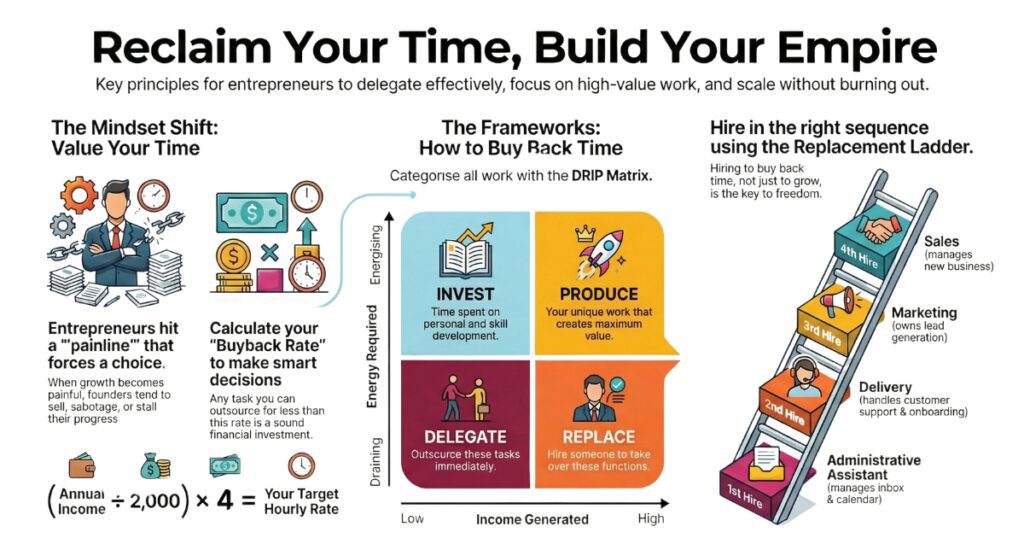
The foundation of Martell’s philosophy begins with a concept he calls the “painline.” Every growing business reaches a point where continued expansion becomes genuinely painful for its founder. This typically occurs around twelve employees or one million dollars in revenue. At this inflection point, the entrepreneur faces a critical choice that will determine their future trajectory.
Martell identifies three common responses to hitting the painline, which he calls the “three S’s.” The first is to sell—when the pain becomes unbearable, many entrepreneurs exit the business entirely, either selling it outright or returning to traditional employment. While this solves the immediate problem, it also eliminates the opportunity to build something meaningful. The second response is sabotage, where entrepreneurs unconsciously undermine their own success by taking on poor-fit projects, hiring the wrong people, or launching doomed product lines. This self-sabotage provides psychological permission to fail, removing the pressure they feel. The third response is stalling, where founders drag their feet on critical decisions and deliberately avoid growth, believing that if they don’t grow, they won’t fail.
None of these responses represent success. Instead, Martell introduces the “buyback loop,” a three-step process that transforms how entrepreneurs relate to their time and their business. First, they must audit their calendar and task list to identify activities that drain energy while costing little to outsource. Second, they transfer these tasks to team members who actually enjoy this work—contrary to common belief, there are people who find joy in administrative tasks, customer service, and other work that drains the founder. Third, they fill the reclaimed time with activities that generate energy, income, and fulfillment.
Principle 2: The DRIP Matrix: Investing Rather Than Spending Your Time
Martell’s framework for categorizing work addresses a fundamental misunderstanding among entrepreneurs. Not all hours are created equal. The way you perceive a task determines how long it feels and how much value it generates. In math class, minutes felt like hours. In art class, hours flew by like minutes. The same principle applies to business tasks.
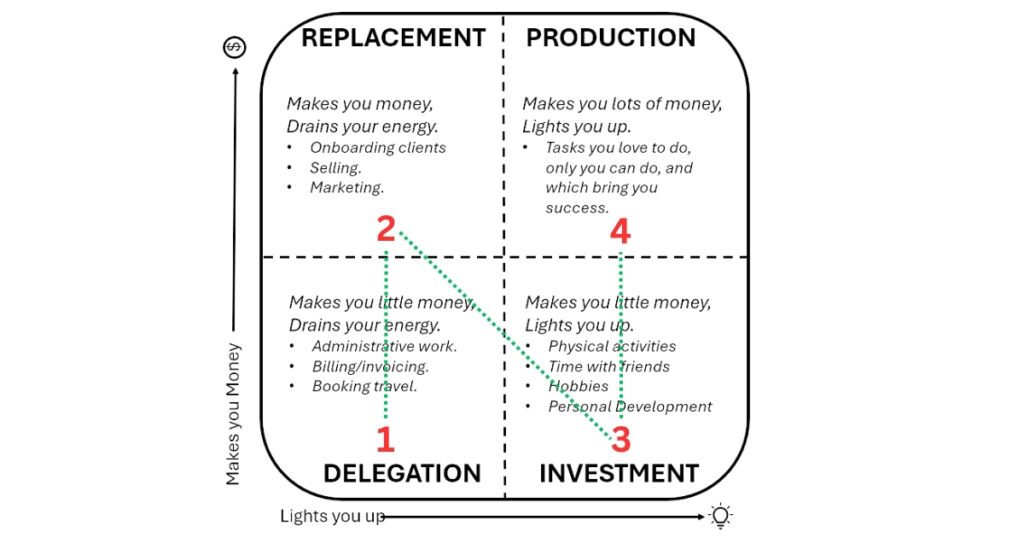
The DRIP Matrix maps all activities across two axes: energy generated (whether work energizes or drains you) and income generated (how much money the work produces). This creates four quadrants, each requiring a different strategy.
The first quadrant, “Delegate,” contains tasks that drain your energy and produce minimal income. These should be deleted, deferred, or delegated immediately. The second quadrant, “Replace,” involves identifying key people to hire who can take over critical functions, freeing you to operate at a higher level. This is where Martell’s replacement ladder becomes essential. The third quadrant, “Invest,” represents time spent developing yourself through skill-building, relationship cultivation, and mindset work. This seemingly unproductive time actually generates tremendous value by making you more capable of leading and growing. The fourth quadrant, “Produce,” is where you do work that energizes you, generates significant income, and represents the highest and best use of your time.
The goal is to systematically move tasks through this matrix, working toward a position where most of your time exists in the “Produce” quadrant. This isn’t laziness or avoiding work—it’s strategic focus on activities where your unique talents create maximum value.
Principle 3: The Buyback Rate Formula: Understanding Your Time’s Real Worth
Before you can effectively buy back your time, you must understand its actual value. Martell’s buyback rate formula is elegantly simple. Take your annual business income, divide by 2,000 (roughly the number of working hours in a year), then multiply by four. This number represents your target hourly rate for outsourcing decisions.
For example, if your business generates $200,000 annually, your time is worth $400 per hour ($200,000 ÷ 2,000 × 4). Any task you can pay someone $400 or less per hour to handle is a sound financial investment. This framework forces entrepreneurs to stop thinking emotionally about money and start thinking strategically about time. If you’re a $400-per-hour entrepreneur spending time on $10-per-hour tasks, you’re destroying wealth, not creating it.
The deeper principle here addresses a pervasive entrepreneur mindset: if you don’t value your own time, nobody else will. Many founders accept lower compensation for their work than their value warrants, or they continue doing work that others could do more cheaply, simply because they haven’t done the math. This formula makes the math inescapable.
Principle 4: The Five Time Assassins: Hidden Productivity Killers
While many productivity systems focus on what to do, Martell identifies what not to do. He describes five common behavioral patterns that sabotage productivity and waste time systematically.
The first assassin is the “Staller,” someone unable to make decisions. They mark emails as unread, create todo lists but don’t act on them, and delay important choices indefinitely. The cost is enormous because delays compound. A delayed hiring decision costs months of founder time that could have been spent on revenue-generating work.
The second is the “Speed Demon,” who moves fast but recklessly. They confuse busyness with productivity, making hasty decisions without reflection. They might hire the first available person because it’s faster than running a proper recruitment process, only to spend months dealing with a poor cultural fit.
The third is the “Supervisor,” the classic micromanager. They scrutinize every piece of work, criticize everything, and maintain constant involvement in execution. This pattern is particularly damaging because it prevents delegation from working—team members never develop autonomy because the founder remains enmeshed in every task.
The fourth is the “Saver,” who penny-pinches relentlessly. They view every dollar spent as a lost dollar, making it impossible to invest in growth, tools, or most importantly, people. The irony is that their frugality prevents growth, ensuring they remain small.
The fifth is the “Self-Medicator,” who uses various addictions to escape the discomfort of growth. Whether food, alcohol, drugs, or entertainment, this person avoids confronting the real issues blocking their progress. They hit a complexity ceiling because they never develop the emotional resilience required to lead at higher levels.
The critical insight is that you can eliminate dozens of hours weekly simply by stopping these patterns—no spending required. This is the cheapest form of buyback available.
Principle 5: The Three Levels of Trading: From Employee to Empire Builder
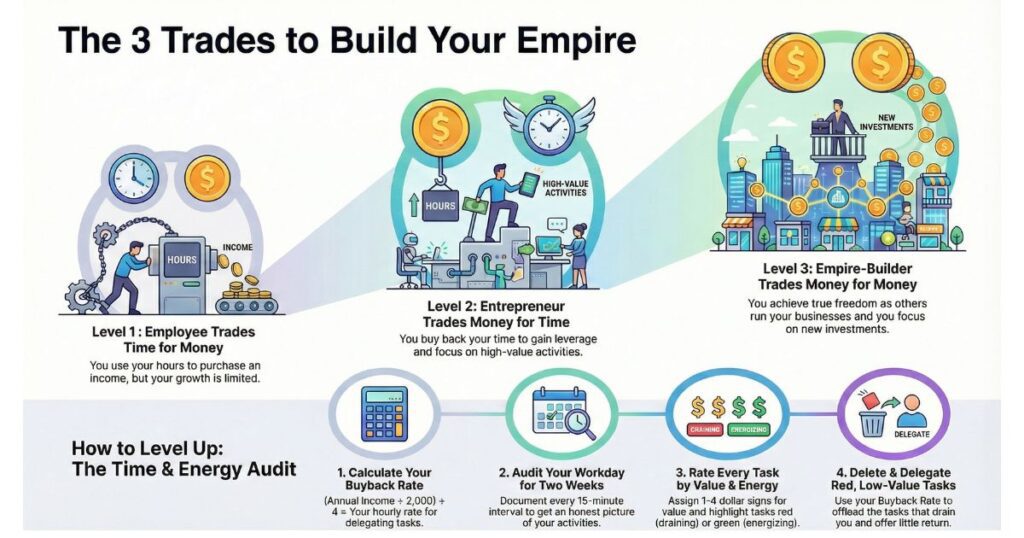
Martell structures economic value creation around three distinct trading models. Understanding which level you operate at fundamentally determines your ceiling.
At level one, you trade your time for money. As an employee or service provider, your income is capped by the number of hours you can work and your hourly rate. Most entrepreneurs begin here, thinking that more work will create more wealth.
Level two is the entrepreneurial model, where you trade money for time. You hire people and invest in systems, then charge clients for results rather than hours. This is the breakthrough many entrepreneurs experience when they start outsourcing, but most never advance beyond it. They get paid for outcomes but still spend most of their time working in the business rather than on the business.
Level three is the empire-building model, where you trade money for money. Your money works for you through investments, assets that generate recurring revenue, and systems that operate without your involvement. This is where true wealth and freedom exist, but most entrepreneurs never make this leap because they remain stuck in level two thinking.
The tragic part is that many entrepreneurs achieve significant success at level two—generating multiple six or seven-figure incomes—but they never make the mental shift required for level three. They remain trapped in trading their time for money, just at a higher hourly rate.
Principle 6: The Time and Energy Audit: Taking Inventory
Before implementing change, you need a complete picture of your current situation. The time and energy audit is deceptively simple but profoundly revealing. Set an alarm for every fifteen minutes during your normal work week and log what you’re actually doing. This prevents the common self-deception where entrepreneurs believe they spend time on revenue-generating activities when they actually spend it in meetings, on email, and on administrative tasks.
Once you have this detailed inventory, assign each task a dollar value from $1 (administrative work anyone could do) to $4+ (specialized work matching your expertise). Then color-code: red for tasks that drain energy, green for those that energize you.
The revelation comes when you see a clear bucket of red, low-dollar tasks. These are your first hiring targets. Most entrepreneurs get this backwards, they hire to add capacity without recognizing that they’re adding to their management burden. The right sequence is to hire for what you should stop doing first.
Principle 7: The Replacement Ladder: The Correct Sequence of Hiring
One of Martell’s most valuable contributions is the Replacement Ladder, which defines the exact sequence of hires that creates freedom rather than additional stress. Getting this sequence right is the difference between scaling successfully and burning out while managing a bloated team.
The first rung involves hiring an administrative assistant and giving them complete ownership of two areas: your inbox and your calendar. This isn’t a partial delegation where you still vet some emails or personally schedule some meetings. It’s complete. Your assistant becomes the gatekeeper of your time and communications. This is transformative because your inbox and calendar directly control your entire day.
The second rung is hiring for delivery—someone who handles customer onboarding and ongoing support. This allows you to focus on selling and strategy rather than getting bogged down in customer success operations.
The third rung is a marketing hire who owns all traffic sources and lead generation. They manage social media, advertising, content, and campaigns with the explicit goal of generating qualified leads twenty-four hours a day.
The fourth rung brings in a sales person who takes responsibility for all new business conversations and follow-up. At this point, with admin, delivery, marketing, and sales in place, you have genuine freedom. The business can function without you for extended periods.
The fifth rung, which Martell calls “Flow,” is a leader-partner who handles strategy, outcomes, and team management. This is different from hiring a COO to run operations. Instead, this person partners with you on vision and strategy while managing execution.
Critical to all this is the Buyback Principle: you don’t hire to grow your business, you hire to buy back your time. This distinction changes everything. When you hire to grow, you add overhead and management burden. When you hire to buy back your time, you’re adding capacity that lets you focus on your highest and best work.
Principle 8: The 10-80-10 Rule: Maintaining Your Fingerprint
One of the deepest fears preventing delegation is that the business will lose its essence, its magic, the founder’s fingerprint. Martell addresses this directly through the 10-80-10 rule, used by leaders like Gary Vee, Elon Musk, and MrBeast.
The first 10 percent is ideation. You sit down with your team, discuss the vision for a project, share resources and relevant past experience, and outline what success looks like. You provide all your expertise about the outcome you want.
The next 80 percent is execution. Your team takes over completely. They conduct research, manage timelines, source materials, and execute the project without your involvement. This is where they develop competence and ownership.
The final 10 percent is integration. The project returns to you for refinement and final approval. You might tweak certain elements, provide feedback, and ensure it aligns with your vision before it goes out into the world.
This structure allows you to maintain creative control and ensure quality while never becoming a bottleneck. You’re involved at the critical thinking points but absent from the grinding execution. Your fingerprint is present through the vision and final integration, not through doing the work yourself.
Principle 9: Building Playbooks: Creating Scalable Systems
Systems are how organizations scale beyond the founder’s personal capacity. McDonald’s famously created playbooks so detailed that a teenager with minimal training can produce an identical product worldwide. Martell adapted this concept for knowledge work through what he calls the “Four C’s of Playbooks.”
The first is the Camcorder. When you’re doing a task you eventually want to delegate, record yourself working and talking through your process. This creates the raw material for delegation. Over time, you’ll transition from author to editor—you’ll conceive of the work but someone else will execute it based on your recordings.
The second is Course. Create detailed written documentation of how to perform a task. Include every step, decision point, and consideration. This becomes a reference guide that enables someone to work with minimal supervision.
The third is Cadence. Establish recurring rhythms for different types of work. Daily tasks like social media posting, weekly tasks like report review, monthly tasks like strategy sessions. Cadence brings predictability and prevents work from falling through cracks.
The fourth is Checklist. This is the final quality control mechanism. It’s not a course or training document; it’s a high-level checklist of what should be completed. Like a pilot’s pre-flight checklist, it ensures critical items are covered without re-training each time.
Principle 10: Your Perfect Week: Designing Your Life
Most entrepreneurs react to their calendar rather than designing it. Martell’s concept of the Perfect Week inverts this. You design your ideal week, then organize your actual commitments around it.
Start with your big rocks—activities that align with your highest values and largest income drivers. These go into your calendar first. These might include revenue-generating meetings, key relationship time, health maintenance, and family commitments. Everything else fits around these non-negotiables.
Next, identify opportunities for batching—grouping similar tasks together rather than scattering them throughout the week. Three hours of uninterrupted creative work is dramatically more productive than six separate one-hour blocks.
Then, optimize for energy. If you have peak creative energy in the morning, schedule your most cognitively demanding work then. If you prefer afternoons for meetings and people interaction, structure your day accordingly.
Finally, look for opportunities for “net time”—where two valuable activities combine rather than compete. A founders hike where people ask you questions combines exercise, mentoring, and personal development. Traveling with team members allows you to both see new places and transfer knowledge. Group dinners let you connect with multiple people simultaneously rather than doing individual one-on-ones.
Principle 11: Transformational Leadership: Building People, Not Just Businesses
The difference between a founder who stays stuck at one million in revenue and one who scales to ten million often comes down to how they lead. Martell distinguishes between transactional and transformational leadership.
Transactional leaders tell people what to do, check that it’s done, then tell them what to do next. This creates a doom loop where the leader remains the bottleneck. Every problem flows up, every decision requires founder input. Eventually, the founder wakes up spending their entire day keeping people busy instead of doing meaningful work.
Transformational leadership starts with outcomes. Instead of giving someone a task, you describe the result you want and what success looks like. You establish measurement systems so they can track progress. You coach them when they get stuck rather than just giving them the answer. Most importantly, you develop their ability to think and solve problems rather than their compliance in following instructions.
Martell’s COACH framework operationalizes this. Core Issue is identifying one specific leverage point that, if improved, would have multiplier effects. Story is sharing a personal anecdote of how you learned this lesson, creating connection and context. Change is asking them to commit to specific behavioral changes based on what you shared. This approach develops people rather than creating dependency.
Principle 12: The CLEAR Principle: Building Trust Through Feedback
High-performing teams require trust, which requires psychological safety, which requires clear communication about concerns and friction. Martell’s CLEAR principle is a structured conversation format that clears emotional debris before it becomes resentment.
Create a warm environment by asking for the conversation one-on-one and appreciating their willingness to be honest. Lead by asking for their feedback, framing it as essential to your growth as a leader. Emphasize by restating what you heard. Ask if there’s more, giving them permission to raise the real issues. Reject or accept by either giving perspective on why you made a decision differently or committing to change.
The power of this framework is that it invites truth-telling before resentment builds. Most teams have unspoken frustrations that poison culture. Leaders who systematically create space for feedback prevent this dynamic.
Principle 13: The Three Phases of a 10X Vision: From Dreams to Reality
Buying back your time isn’t the end goal—it’s the means to an end. The real point is to create space for building something bigger than yourself. Martell outlines three phases for creating a 10X vision.
Phase one is dreaming without limits. Most people dream small because they can’t imagine what’s possible. Big dreams are actually easier to execute than small ones because they make daily decisions crystal clear. Every opportunity can be evaluated against your vision. Either it moves you closer to that dream or it’s a distraction.
Phase two is creating a clear vision across multiple dimensions. What team do you want to work with? What kind of business appeals to you? What lifestyle do you want to live? How do you want your family involved? How do you want to impact your community? Vision isn’t just business metrics; it’s a holistic picture of the life you’re building.
Phase three is living in the energy of that vision before it’s real. Visualization isn’t magical thinking; it’s nervous system training. When you regularly imagine and feel the experiences of your ideal future, you develop the frequency of that person. You notice opportunities that aligned with that vision. You attract people and situations that match your energy.
Principle 14: The Preloaded Year: Planning for Exponential Results
Most people overestimate what they can do in a year while underestimating what they can do in a decade. With proper planning, you can achieve more in a year than many accomplish in a decade. Martell’s preloaded year strategy makes this possible.
It starts with rocks, pebbles, and sand—the famous metaphor about priority. You first place your big rocks (the critical priorities), then pebbles fit around them, then sand fills the remaining space, and finally water tops it off. If you start with sand and water, there’s no room for rocks.
Next, add maintenance—the non-negotiable practices that prevent problems. Weekly check-ins with your spouse, quarterly retreats, health practices, family rituals. These aren’t luxuries; they’re preventive medicine that protects what matters most.
Then comes commitment. You establish your year plan and commit to it regardless of motivation fluctuations. This is where discipline enters, but it’s specific discipline toward clearly defined outcomes, not general grinding.
Finally, establish a review and adjust cycle. At the year’s end, revisit what you committed to and honestly assess what was worth repeating. What lit you up? What was “meh”? Cut the meh and create space for new experiments.
Principle 15: The Buyback Lifestyle: Freedom Beyond the Business
Ultimately, buying back your time isn’t just about business freedom—it’s about life freedom. Martell outlines four levels of buying back your personal life.
Level one is cleaning and errands. If you can afford it, someone should clean your house and run your errands. This isn’t weakness; it’s recognizing that you’re paying someone to do something your time isn’t suited for, while freeing your time for what only you can do.
Level two is meals and supplies. Meal prep services, grocery delivery, and supply replenishment are all available. These hours add up quickly and are valuable time with family or business.
Level three is family support. This one requires shifting your identity as a parent. You might hire someone to handle school pickup and drop-off, freeing you to be more present during actual family time rather than stressed about logistics.
Level four is projects and ownership. At the highest level, someone serves as the CEO of your personal life, handling real estate, vehicle maintenance, travel, and projects. This is the ultimate freedom—your time is either spent with people you love or creating value only you can create.
Conclusion: The Freedom Beyond the System
Dan Martell’s “Buy Back Your Time” isn’t ultimately about hacks or optimization tricks. It’s about restructuring your relationship with time and work to create the space for what actually matters. The fifteen principles he outlines are a framework, but the true transformation comes when you genuinely believe that your time is valuable and that you deserve to spend it on what energizes and fulfills you.
The book’s deepest message is that you’re allowed to dream big, that building an empire is not only possible but worth pursuing, and that the path there requires you to become comfortable being uncomfortable. Every delegation is an act of faith. Every system you build is an investment in freedom you don’t yet feel. But on the other side of that work is a life of genuine autonomy where you control your calendar, engage with people you choose, and create value that matters to you. That’s worth the temporary discomfort of learning to let go.
Links:
Dan Martell’s website
The Speaker Lab podcast